Home Addition Contractors Near Me: How to Find the Right Builder
The best way to find home addition contractors near me is to start with your state’s licensing board and a review platform, check each builder’s licence, insurance and recent projects, and then get at least three detailed written estimates before you choose. A home addition is one of the biggest projects a homeowner can take on, with a national average cost of about 50,523 dollars according to Angi data from October 2026, so the contractor you hire matters more than it does for almost any other job. A good builder will guide you through design, permits, construction and inspections, while a bad one can leave you with a half-finished room, a blown budget and a legal mess, which is why this guide explains where to look, what a home addition costs, which permits you need, and the checks that separate a professional builder from a risky one.
You do not need to understand construction to hire a good contractor, but you do need a method. The sections below give you that method, with cost figures from Angi and from the JLC and Zonda Cost vs Value report as of November 2026, so you can search for home addition contractors near me with a clear sense of what the work involves, what it should cost, what to expect at each stage of the project, and what to watch out for before you sign anything.
Where Can You Find Home Addition Contractors Near Me?
The best place to start looking for home addition contractors near me is with the same sources that work for any major home project: your state licensing board, a review platform such as Angi or the Better Business Bureau, and recommendations from people you trust who have had similar work done. A general web search will return plenty of names, but a listing alone tells you nothing about whether a contractor is licensed, insured or experienced with additions specifically, so treat search results as a starting point rather than a shortlist. The most reliable starting point is a recommendation from a neighbour or a friend who has recently completed an addition, because they can tell you how the builder communicated, whether the work finished on time, and whether the final cost matched the estimate.
Once you have a few names, check each one against your state licensing board, which in most states runs an online lookup where you can search by licence number, business name or person name, and which often discloses complaints. Then look at the same names on a review platform to see what recent customers say about punctuality, communication, cleanliness and whether the work passed inspection on the first attempt. A home addition is not a job for a general handyman or a contractor whose main work is painting or roofing: look for builders who list additions and extensions as a core service, who can show you photographs of completed additions, and who can provide references from addition projects in the last year or two. If your local search returns few specialists, widen it to your metro area, since many addition contractors serve several counties, and once you have candidates that cover your address, run the licence and insurance checks before you request any estimates.
How Much Does a Home Addition Cost in 2026?
A home addition is expensive, and the national figures give you a useful anchor before you start collecting quotes. Angi reports, based on 5,609 projects and updated on 28 October 2026, that the national average cost of a home addition is 50,523 dollars, typically ranging from 21,886 to 82,670 dollars, although small additions can cost far less and large, high-end additions can cost far more. The cost per square foot depends on whether you build out or build up: building out, which means adding a room at ground level, typically costs 80 to 200 dollars per square foot, while building up, which means adding a second storey, typically costs 300 to 500 dollars per square foot, because it requires structural work on the existing house.
The type of room matters just as much as the size. A bedroom addition typically costs 80 to 160 dollars per square foot, while a bathroom addition typically costs 150 to 200 dollars per square foot, because bathrooms need plumbing, waterproofing and fixtures. Labour is the largest single cost, typically accounting for 40 to 60 percent of the total, or roughly 28,000 to 42,000 dollars on an average project, and an architect typically costs 2,400 to 14,000 dollars depending on the complexity of the design. It is also worth knowing what the work returns: according to the JLC and Zonda Cost vs Value report, a midrange bathroom addition recoups about 53 percent of its cost at resale, which means an addition is an investment in your home’s livability first and its value second. Use those national figures as a guide, and let your own quotes set the real price for your house.
What Types of Home Additions Can You Build?
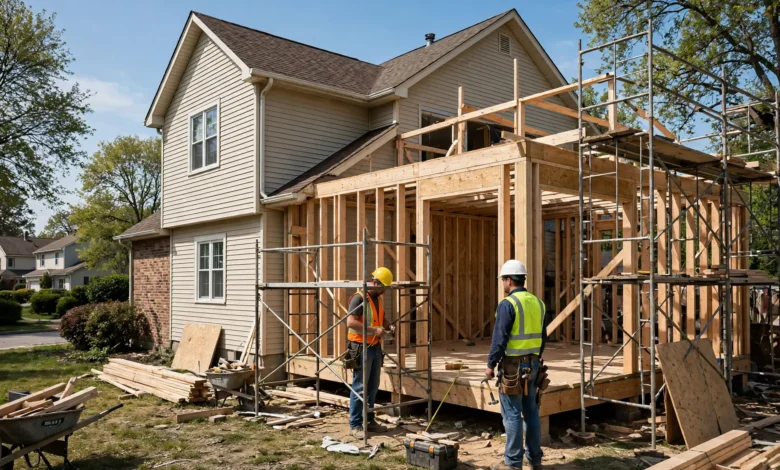
A home addition is not one job but several, and the type you choose determines the cost, the timeline and the permits you need. Building out is the most common option: a ground-floor room addition, such as a bedroom, a family room or a kitchen extension, that expands the footprint of your house, and it is generally the cheapest per square foot because it does not require structural work on the existing roof. Building up means adding a second storey or a dormer, and it costs more per square foot because the existing structure must be reinforced, the roof must be removed and rebuilt, and the work is more disruptive, but it is the right choice when your lot is small and you cannot expand outwards.
A bathroom addition is one of the most popular single-room projects, because an extra bathroom changes daily life more than almost any other addition, but it is also one of the most expensive per square foot because of the plumbing and fixtures. A sunroom or a conservatory is a lighter option that adds living space with large windows and less structural work, while a garage conversion, which turns an existing garage into living space, is not technically an addition but achieves a similar result at a lower cost. The right choice depends on what your household needs, what your lot and your local zoning allow, and what your budget supports, and a good contractor will walk you through those options during the first consultation rather than pushing the most expensive one.
What Permits and Rules Do You Need for a Home Addition?
A home addition almost always requires permits, and the permitting process is one of the longest parts of the project, so it pays to understand it before you start. Most municipalities require a building permit for any addition that changes the footprint or the structure of a house, and the application typically needs architectural drawings, a site plan and proof that the design meets local zoning rules, building codes and setback requirements. Permit timelines vary widely by location, but the process can take between four and twelve weeks, which is why a good contractor will start the paperwork early and will not promise a start date until the permit is in hand.
Zoning rules are the other constraint to understand, because they limit how much of your lot you can build on, how close to the boundary you can build, and how tall the addition can be. A contractor who works in your area should know those rules, but you should also check them yourself with your local planning department, because a design that violates zoning will be rejected and will cost you time and money. Your contractor should also arrange the inspections that happen during construction, including framing, electrical and plumbing inspections, because work that has not been inspected can cause problems when you sell the house. If a contractor suggests skipping permits to save time or money, treat that as a serious red flag and find another builder, because unpermitted work can be ordered to be removed and can make your home unsellable.
What Should You Ask Before Hiring a Home Addition Contractor?
A home addition is a months-long relationship with your contractor, so the conversation before you hire matters more than it does for a small job. Start by asking how long the company has been building additions and whether it has completed projects similar to yours, because experience with your type of addition matters more than the number of years in business alone. Ask to see photographs of completed additions and to speak with two or three recent customers, and ask who will actually be on site each day and who will supervise the work, since some companies send a salesperson to quote the job and a different crew to do it.
Then ask about the practical details that affect the result: whether the company will handle the architectural drawings and the permit application, how long the project will take from breaking ground to completion, how the work will be scheduled around your family’s daily life, how the site will be kept clean and safe, and what warranty covers the work. A professional should explain the process in simple language, should be willing to put the scope, the price, the payment schedule and the warranty in writing, and should be honest about the disruptions an addition causes, including noise, dust and periods when parts of your home are unusable. If the answers are vague, if the contractor pressures you to sign on the spot, or if the company cannot explain its warranty in plain terms, those are reasons to get another quote rather than to argue.
What Are the Red Flags When Hiring a Home Addition Contractor?
Several warning signs should make you pause before hiring a home addition contractor, and the most serious is any reluctance to show a licence, insurance or references. A company that cannot produce a current licence where one is required, or that will not share a certificate of insurance, is asking you to take on risk that belongs to them, and no discount is worth that trade. The same applies to a company that demands a large payment upfront, refuses to provide a written estimate, or suggests skipping permits to save time, because a professional job comes with paperwork that protects both sides, and the absence of that paperwork is itself the warning.
Other red flags are subtler but just as telling. Be cautious of a quote that is dramatically cheaper than every other estimate, because it usually means corners will be cut somewhere, whether in materials, labour or inspections. Be wary of a contractor who cannot show you photographs of completed additions, who will not let you speak with recent customers, or who promises an unrealistically short timeline without explaining how it will be achieved. Online reviews help here too: look for patterns rather than single complaints, and pay attention to mentions of projects running months over schedule or costs doubling after the work started, because those are the problems that turn a dream addition into a nightmare. A careful builder welcomes scrutiny and a careless one avoids it, so trust the builder who answers your questions rather than the one who dismisses them.
How Do You Compare Home Addition Quotes Fairly?
Getting at least three estimates is the standard advice for hiring home addition contractors, and it works, but only if you compare the quotes properly rather than simply picking the lowest number. A useful estimate should explain the scope of the work, the materials, the labour, the architectural and permit costs, the timeline and the payment schedule, and you should ask about anything that is unclear before agreeing to the work. Price differences are common because contractors may use different materials, different construction methods and different labour plans, and the condition of your existing house can also affect the cost, so two quotes for the same addition can legitimately differ by thousands of dollars.
Before choosing the lowest quote, make sure you are comparing similar work, because a slightly higher estimate may include important items such as architectural drawings, permit fees, structural engineering or a longer warranty, while the cheaper one may leave those out and add them as extras later. Check that each quote covers the same rooms and the same finishes, ask whether the price is fixed or an estimate that can change, and confirm the payment schedule in writing, with most of the payment tied to completed milestones rather than paid upfront. The goal is not to find the cheapest builder or the biggest one, but to find the contractor who understands your house, explains the work clearly, and gives you a detailed estimate you can hold them to, because that is the builder whose addition will still be serving your family well years after the work is done.
Conclusion
Finding good home addition contractors near me comes down to a simple method: ask for recommendations, check each candidate’s licence and insurance with your state board, look for builders who specialise in additions and can show you recent projects, and then compare at least three detailed written estimates before you choose. A home addition typically costs between 21,886 and 82,670 dollars nationally, with an average of about 50,523 dollars according to Angi data from October 2026, and the final figure depends on whether you build out or build up, what kind of room you add, and where you live. Permits can take four to twelve weeks, so start the paperwork early, and never let a contractor talk you into skipping them.
The cheapest quote is rarely the best value, and the most expensive is not automatically the best work, so judge each contractor on its experience, its paperwork, its willingness to answer questions and the detail in its estimate. Ask about design, permits, timelines, disruption and warranties, watch for the red flags of missing licences, missing insurance, large upfront payments and high-pressure sales, and choose the builder who treats your home like a project rather than a sale. Do that, and the addition you build will do what it is supposed to do: give your family the space it needs, make your home more comfortable, and add value that lasts long after the builders have gone.
How much does a home addition cost?
A home addition typically costs between 21,886 and 82,670 dollars nationally, with an average of about 50,523 dollars, according to Angi data from October 2026 based on 5,609 projects. Building out, which means adding a room at ground level, typically costs 80 to 200 dollars per square foot, while building up, which means adding a second storey, typically costs 300 to 500 dollars per square foot. A bedroom addition typically costs 80 to 160 dollars per square foot, while a bathroom addition typically costs 150 to 200 dollars per square foot, because bathrooms need plumbing, waterproofing and fixtures. Labour typically accounts for 40 to 60 percent of the total, and an architect typically costs 2,400 to 14,000 dollars. Always get at least three written estimates for your own home rather than relying on national averages alone.
How do I find home addition contractors near me?
Start with recommendations from neighbours or friends who have recently completed an addition, and then check each candidate against your state licensing board, which in most states runs an online lookup by licence number, business name or person name. Review platforms such as Angi and the Better Business Bureau also list local addition contractors with customer reviews, and they are useful for seeing what recent customers say about communication, punctuality and whether the work passed inspection. Look for builders who list additions as a core service, who can show you photographs of completed additions, and who can provide references from addition projects in the last year or two. If your local search returns few specialists, widen it to your metro area, since many addition contractors serve several counties.
Do I need a permit for a home addition?
Yes, a home addition almost always requires a building permit, and the permitting process is one of the longest parts of the project. Most municipalities require a building permit for any addition that changes the footprint or the structure of a house, and the application typically needs architectural drawings, a site plan and proof that the design meets local zoning rules, building codes and setback requirements. Permit timelines vary widely by location, but the process can take between four and twelve weeks. Your contractor should handle the application and arrange the inspections that happen during construction, including framing, electrical and plumbing inspections. If a contractor suggests skipping permits to save time or money, find another builder, because unpermitted work can be ordered to be removed and can make your home unsellable.
How long does a home addition take?
How long a home addition takes depends on the size and type of the project, the permit timeline and the weather, so there is no single answer that fits every home. A small ground-floor room addition may take two to three months from breaking ground to completion, while a second-storey addition or a large multi-room project can take six months or more, and the permit process alone can add four to twelve weeks before construction even begins. Your contractor should give you a written timeline as part of the estimate, including the key milestones, how the work will be scheduled around your family’s daily life, and how delays will be handled. If a company cannot give you a clear timeline in writing, or promises an unusually fast job without explaining how, treat that as a reason to get another quote.
Is a home addition worth the money?
A home addition is worth the money if your family needs the space and you plan to stay in the home long enough to enjoy it, but it should be judged as an investment in livability first and in resale value second. According to the JLC and Zonda Cost vs Value report, a midrange bathroom addition recoups about 53 percent of its cost at resale, which means you will not get all of your money back when you sell, but you will have gained years of extra space in the meantime. An addition makes most sense when moving is not practical or desirable, when the neighbourhood supports the investment, and when the design fits the existing house rather than overwhelming it. A good contractor will be honest about the costs and the returns, and will help you choose an addition that serves your family rather than the largest project your budget allows.