1 Gram of Gold Price: How Much Is 1g of Gold Worth Today?
The 1 gram of gold price is a small number with a big story behind it, and the direct answer is that one gram of pure 24-karat gold was worth around $115 in late November 2026, based on a spot price of roughly $3,570 per troy ounce. That works out to roughly £85 per gram in the UK at the current exchange rate, although the price you actually pay a dealer will be higher, because dealers add a premium over the spot price and small bars carry the largest premiums of all. Gold prices move every minute while markets are open, so the figure in this article is a snapshot from 25 November 2026 rather than a live quote, and anyone buying or selling should check the current spot price on the day. This guide explains how the 1 gram of gold price is calculated, what a gram is worth at each purity, why the retail price is higher than the spot price, and whether a one-gram bar is a sensible way to own gold.

How Much Is 1 Gram of Gold Worth Right Now?
As of 25 November 2026, the spot price of gold was trading at roughly $3,570 per troy ounce, which puts the 1 gram of gold price at about $114 to $115 for pure 24-karat gold. A troy ounce is the unit gold is traded in, and it weighs 31.1035 grams, so the price of one gram is simply the price of an ounce divided by 31.1035. That maths is the same everywhere in the world, which is why a gram of gold costs roughly the same in London, New York or Dubai once currency is converted. In pounds, the same gram was worth roughly £85 in late November 2026, although the pound figure moves with the exchange rate as well as with the gold price itself. It is worth remembering that gold has had a dramatic year: it reached a 52-week high of around $5,600 per troy ounce in January 2026, then fell back sharply, and by late November it was trading more than a third below that peak. That fall is a reminder that gold is not a one-way bet, and that the 1 gram of gold price you see today can look very different a few months from now. Anyone quoting you a price for a gram of gold should be able to show you the live spot price it is based on, and if they cannot, you are talking to the wrong dealer.
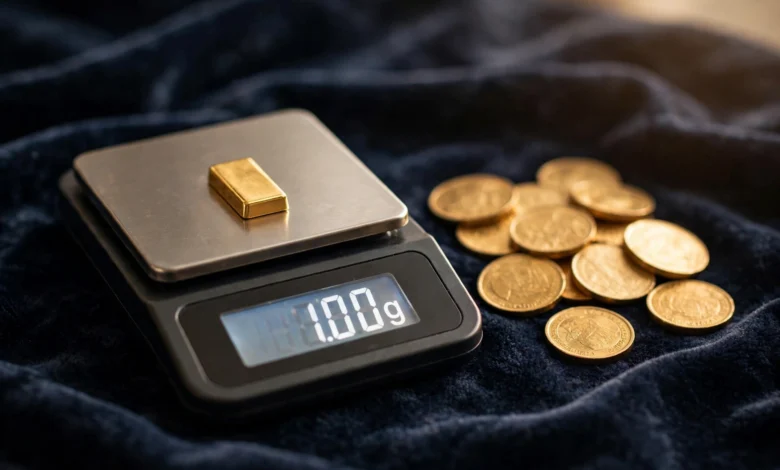
The price also depends on what you mean by “a gram of gold”, because not all gold is pure. A gram of 24-karat gold is 99.9 percent pure gold, and it is the figure the spot price describes. A gram of 22-karat gold, the purity used for most British jewellery and for gold Sovereigns, is 91.6 percent pure, so it contains 0.916 grams of pure gold and is worth proportionally less — around $105 per gram at the same spot price. A gram of 18-karat gold is 75 percent pure and worth around $86, a gram of 14-karat gold is 58.5 percent pure and worth around $67, and a gram of 10-karat gold is 41.7 percent pure and worth around $48. Jewellers and dealers test purity before they quote, and a hallmark stamped on a piece of jewellery tells you its karat, so check the hallmark before you accept a price. The weight matters too: a gram is a small amount, about the weight of a paperclip, and a one-gram bar is roughly the size of a fingernail, which is why it is popular as a gift and as a first step into gold, but also why its price per gram is higher than that of a larger bar.
How the 1 Gram of Gold Price Is Calculated
The 1 gram of gold price starts with the spot price, which is the price for immediate delivery of one troy ounce of unfabricated gold on the global over-the-counter market, quoted continuously while markets are open. The most widely watched benchmarks are the London Bullion Market Association prices and the COMEX gold futures contract in the United States, and the two usually sit within a few dollars of each other. To get the price of a gram, the spot price is divided by 31.1035, the number of grams in a troy ounce, which is not the same as an ordinary ounce — an ordinary avoirdupois ounce is 28.35 grams, and confusing the two is a classic mistake that makes gold look cheaper than it is. The result is the price of one gram of pure gold, before any dealer premium, and it changes constantly during trading hours, so a price quoted in the morning can be out of date by the afternoon. Reputable dealers display a live price that updates through the day, and many will lock a price for a short period while you complete a purchase. If a dealer quotes a price that is far from the spot price without explaining why, ask them to show their workings, because the calculation itself is simple and there is no honest reason to hide it.
Currency is the second ingredient in the calculation, and it matters a great deal for UK buyers. Gold is priced in US dollars worldwide, so the sterling price of a gram depends on the dollar-to-pound exchange rate at the moment of the trade. When the pound is strong against the dollar, gold looks cheaper in pounds even if the dollar price has not moved, and when the pound weakens, the sterling price rises. That is why the sterling price can move even on days when the gold market itself is quiet. Some UK dealers quote in pounds and update their prices several times a day, while others quote in dollars and convert at checkout, and either approach is fine as long as the conversion is transparent. The practical lesson is to compare the dealer’s price with the live spot price in the same currency at the same moment, because a comparison made hours apart is meaningless when both the gold price and the exchange rate are moving. For a one-gram purchase the currency effect is only a pound or two, but for larger purchases it can be the difference between a fair price and a poor one.
1 Gram of Gold Price by Purity: 24K, 22K, 18K and 14K

Purity is the single biggest factor in what a gram of gold is worth, and understanding karats saves you from the most common mistake in gold buying. Karat measures how much of a piece is pure gold, with 24 karat meaning 99.9 percent pure, 22 karat meaning 91.6 percent, 18 karat meaning 75 percent, 14 karat meaning 58.5 percent and 10 karat meaning 41.7 percent. At a spot price of around $3,570 per troy ounce, the value of the gold content in one gram works out to roughly $115 for 24 karat, $105 for 22 karat, $86 for 18 karat, $67 for 14 karat and $48 for 10 karat, and in pounds those figures are roughly £85, £78, £64, £50 and £36. Those are the values of the gold content only, not the price you will pay in a shop, and they assume the piece is exactly the purity it claims to be. British hallmarks make that easy to check: a piece stamped 999 is 24 karat, 916 is 22 karat, 750 is 18 karat, 585 is 14 karat and 417 is 10 karat, and a reputable dealer or jeweller will test an unmarked piece before quoting. If you are selling jewellery, expect the dealer to weigh it, test the purity, and pay you for the gold content at a rate below the spot price, because they need a margin to refine and resell it.
The purity also decides what the gold is good for. Pure 24-karat gold is soft, which is why it is used for bars, coins and investment, but it scratches and bends easily, so it is rarely used for everyday jewellery. British jewellery is usually 22 karat or 18 karat, because the other metals mixed in — copper, silver, zinc and sometimes palladium — make it hard enough to wear every day, and the colour changes with the mix: more copper gives rose gold, more silver and palladium gives white gold. Gold Sovereigns and Britannias, the two most popular British gold coins, are 22 karat and 24 karat respectively, and both are legal tender, which has a useful tax consequence explained below. When you see a gold price advertised by the gram, always ask which purity it refers to, because a price that looks like a bargain for a gram of gold is usually a price for 18-karat or 14-karat gold rather than pure gold. The honest dealers state the purity next to the price, and the ones that do not are telling you something about themselves.
Why the Price You Pay Is Higher Than the Spot Price
The price you pay for a gram of gold is always higher than the spot price, and the gap is called the premium, which covers the cost of refining the gold, manufacturing the bar or coin, packaging it, insuring it, and the dealer’s margin. The premium is charged as a percentage over spot, and it is proportionally largest on the smallest items: a one-kilogram bar might carry a premium of one or two percent, a one-ounce coin might carry three to five percent, and a one-gram bar can carry a premium of ten percent or more, because the manufacturing and packaging cost is spread over a tiny amount of gold. That means a one-gram bar that contains about $115 of gold at the spot price might sell for $130 or more, and when you sell it back, the dealer will buy it below the spot price, because they also need a margin on the way back. The round trip — the difference between the price you pay and the price you can sell for — is the real cost of owning a small amount of gold, and on a one-gram bar it can be fifteen to twenty percent, which is why small bars are a poor way to invest a large sum. They are a reasonable way to start, or to give as a gift, but anyone buying gold as an investment should compare the premium on a one-gram bar with the premium on a larger bar or coin before deciding.
Premiums also vary between dealers, and shopping around is worth real money. Online bullion dealers usually charge lower premiums than high-street jewellers, because their costs are lower and they sell in volume, while a jeweller’s price includes the cost of a shop, staff and display. Some dealers publish a live price list that updates with the spot price, and some will hold a quoted price for a few minutes while you decide, which is useful when the market is moving quickly. Delivery and insurance are sometimes added on top, so check whether the price you see includes them, and check the dealer’s buy-back policy before you purchase, because a dealer who will not buy back what they sell is a dealer to avoid. Payment method can matter too: some dealers charge more for card payments than for bank transfers. None of this makes gold a bad purchase, but it does mean the 1 gram of gold price you see advertised is the starting point of the conversation, not the final price, and the gap between the two is where careful buyers save money.
1 Gram Gold Bars vs Coins vs Jewellery: Which Holds Value Best?
A one-gram gold bar, a gold coin and a piece of gold jewellery all contain gold, but they hold their value very differently, and the difference comes down to how much of the price is gold and how much is everything else. A one-gram bar from a recognised refiner is the purest form of small gold ownership: it is 99.9 percent pure, it comes sealed in a tamper-proof card with a certificate, and its value tracks the spot price closely, minus the premium described above. A gold coin such as a Sovereign or a Britannia carries a higher premium than a bar of the same weight, because coins cost more to mint and carry a design people are willing to pay for, but British legal tender coins have a tax advantage that bars do not: they are exempt from Capital Gains Tax, because the law treats them as currency rather than an investment. Jewellery is the worst of the three as a store of value, because a large part of what you pay is the design, the craftsmanship and the retailer’s margin, and when you sell it back, a dealer will pay only for the gold content at below the spot price, so a ring that cost £500 may contain only £200 of gold. That does not make jewellery a bad purchase — it is bought to be worn, not to be an investment — but it does mean you should never buy jewellery expecting to get your money back.
If the goal is to own gold as a small, affordable first step, a one-gram bar from a well-known refiner such as PAMP, Heraeus or the Royal Mint is a sensible choice, because it is easy to store, easy to sell, and its purity is guaranteed by the sealed packaging. If the goal is to build a holding over time, buying a larger bar or a coin once you can afford it will cost you far less per gram in premiums, and a Sovereign or Britannia adds the Capital Gains Tax advantage. If the goal is a gift, a one-gram bar in its sealed card is hard to beat, because it is beautiful, it is clearly genuine, and it introduces the recipient to gold without a large outlay. Whatever form you choose, buy from a dealer who is a member of a recognised body, who publishes live prices, and who offers a buy-back, and keep the receipt and the certificate, because they are what prove the gold is genuine when you come to sell it. And remember that gold pays no interest or dividends, so it is a store of value rather than an income-producing investment, and it should sit alongside other savings rather than replacing them.
Where to Buy 1 Gram of Gold in the UK
The safest places to buy a gram of gold in the UK are established bullion dealers, either online or in person, and the Royal Mint itself. Online dealers such as BullionByPost, GoldCore and Atkinsons publish live prices, deliver insured, and buy back what they sell, while the Royal Mint sells its own bars and coins direct and is the official maker of British coinage. High-street jewellers also sell small gold bars, but their premiums are often higher, so compare their price with an online dealer before you buy. Some banks and building societies do not sell physical gold to retail customers, and buying gold from a private seller, a market stall or an auction site carries real risks, because counterfeit bars exist and a fake one-gram bar is easy to produce. Always check that the dealer is a member of the British Numismatic Trade Association or the London Bullion Market Association, read recent reviews, and make sure the bar comes sealed with a certificate from a recognised refiner. Payment by bank transfer is standard for bullion dealers, and a dealer who insists on cash or cryptocurrency should be treated with caution.
There are two tax points that UK buyers should know before they buy a gram of gold. First, investment-grade gold — bars and coins of at least 99.5 percent purity — is exempt from VAT in the UK, so you should not be charged VAT on a one-gram investment bar, and if a dealer tries to add it, something is wrong. Second, Capital Gains Tax applies to gains on gold bars when you sell them, above your annual allowance, but British legal tender coins such as Sovereigns and Britannias are exempt from Capital Gains Tax, which is one reason they are popular with UK investors. A one-gram bar does not carry that exemption, so if you sell it at a profit above your allowance, the gain is taxable. Tax rules change, and this is general information rather than tax advice, so check the current rules on GOV.UK or speak to an accountant if you are buying in quantity. Finally, store small gold safely: a home safe is fine for a gram or two, but for larger holdings a bank safety deposit box or the dealer’s own insured storage is worth considering, and tell your home insurer about it, because many household policies have a low single-item limit for valuables.
Conclusion
The 1 gram of gold price was around $115 for pure 24-karat gold in late November 2026, based on a spot price of roughly $3,570 per troy ounce, or roughly £85 a gram in the UK — but that is the value of the gold content, not the price you will pay. Dealers add a premium that is proportionally largest on small bars, so expect to pay more than the spot price and to sell back for less, and compare premiums between dealers before you buy. Check the purity, because a gram of 22-karat gold is worth around $105 and a gram of 18-karat gold around $86 at the same spot price, and always buy investment-grade bars from a recognised dealer with a certificate. A one-gram bar is a lovely gift and a sensible first step into gold, but for serious investment a larger bar or a Capital Gains Tax-exempt Sovereign or Britannia will cost you less per gram. Check the live price on the day you buy, because gold moves every minute, and in a year when it has already fallen by more than a third from its January peak, that is advice worth taking.
How Much Is 1 Gram of 24K Gold?
One gram of 24-karat gold was worth around $115 in late November 2026, based on a spot price of roughly $3,570 per troy ounce. In the UK that is roughly £85 per gram at the current exchange rate, before any dealer premium.
How Much Is 1 Gram of 22K Gold?
One gram of 22-karat gold was worth around $105 in late November 2026, because 22-karat gold is 91.6 percent pure and contains 0.916 grams of pure gold. That is roughly £78 per gram in the UK, before any dealer premium.
Is 1 Gram of Gold a Good Investment?
A one-gram bar is a reasonable first step into gold and a popular gift, but it is not the most cost-effective investment, because the dealer premium on a one-gram bar can be ten percent or more. Larger bars and coins cost less per gram, and British Sovereigns and Britannias are exempt from Capital Gains Tax.
Does the Gold Price Change Daily?
Yes, the gold price changes constantly while markets are open, and it can move several percent in a single day. In 2026 it reached around $5,600 per troy ounce in January and had fallen to around $3,570 by late November, so always check the live spot price on the day you buy or sell.
Is There VAT on Gold in the UK?
No, investment-grade gold — bars and coins of at least 99.5 percent purity — is exempt from VAT in the UK. You should not be charged VAT on a one-gram investment bar, and British legal tender gold coins are also exempt from Capital Gains Tax.
Sources: GoldPrice.com | Melt Value