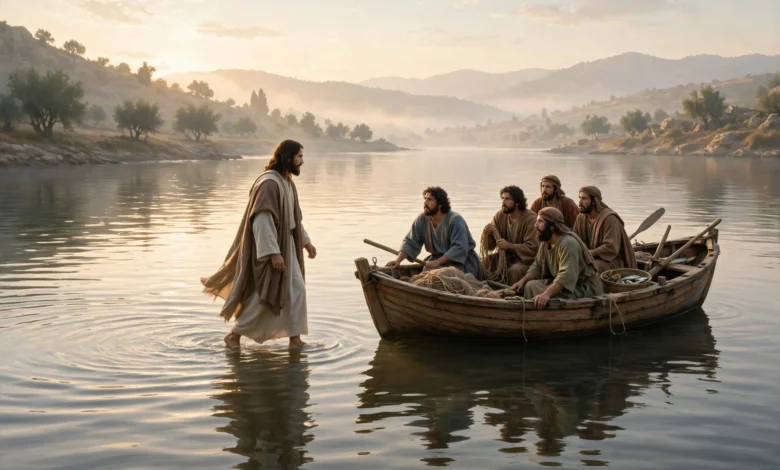
When Jesus walks on water, the disciples see him coming toward their boat across the Sea of Galilee in the middle of a stormy night, and the story has comforted and challenged Christians for two thousand years. The short answer is that after feeding the five thousand, Jesus sent his disciples ahead by boat, went up a mountain to pray alone, and then walked across the water to reach them in the fourth watch of the night, between about 3am and 6am, calming the wind when he stepped into the boat. Peter briefly walked on the water too, then began to sink when fear overtook his faith, and Jesus caught him with the words, “You of little faith, why did you doubt?” The story is told in Matthew 14:22-33, with shorter accounts in Mark 6:45-52 and John 6:16-21, and this guide explains each version, what the miracle meant, and why it still matters today.

What Happened When Jesus Walks on Water?
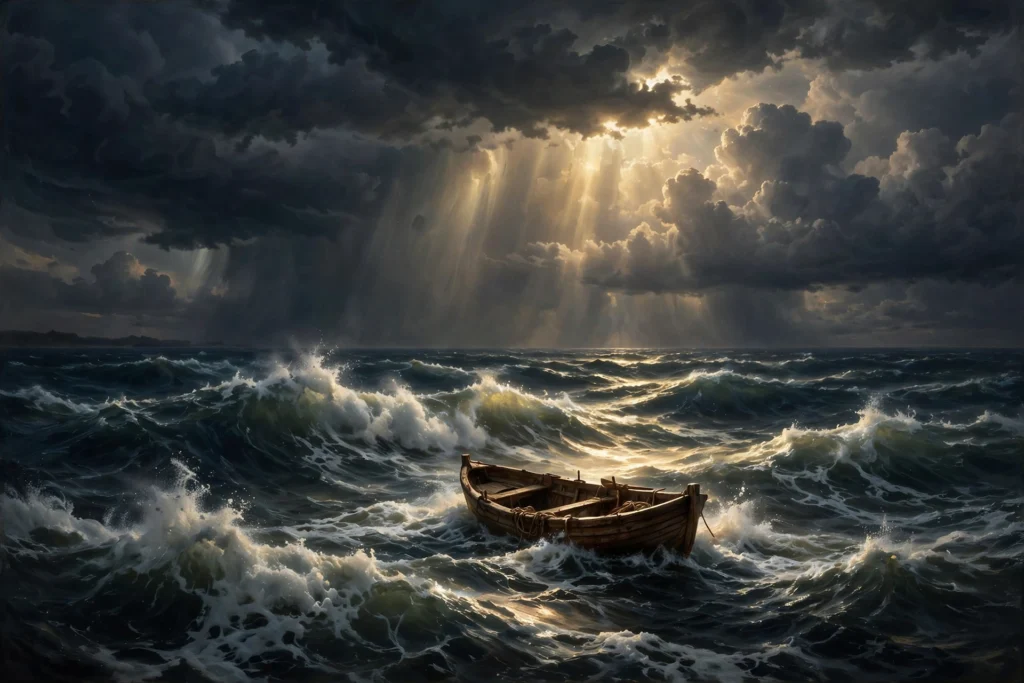
The story of Jesus walks on water begins immediately after one of his most famous miracles, the feeding of the five thousand, when Jesus tells his disciples to get into their boat and cross the Sea of Galilee ahead of him while he dismisses the crowds. He then goes up a mountainside alone to pray, and by evening he is still there by himself while the boat is already a considerable distance from land, battered by waves because the wind is against it. The disciples spend hours rowing through the night, making slow progress against the wind, and it is only in the fourth watch, the darkest hours before dawn, that they see a figure coming toward them across the water. At first they are terrified, convinced they are seeing a ghost, and they cry out in fear, but Jesus speaks at once with words that have echoed through Christian history ever since: “Take courage! It is I. Don’t be afraid.”
The most dramatic moment follows when Peter, impulsive and brave in equal measure, calls out that if it really is the Lord, he should be told to come to him on the water, and Jesus answers with a single word, “Come.” Peter climbs out of the boat and walks on the water toward Jesus, doing the impossible for a few steps, until he notices the wind, becomes afraid, and begins to sink, crying out, “Lord, save me!” Jesus reaches out his hand immediately and catches him, asking why he doubted, and then the two of them climb into the boat together, the wind dies down, and the disciples worship Jesus, saying, “Truly you are the Son of God.” The whole scene moves in a few verses from terror to faith to doubt to rescue to worship, which is why it has become one of the most retold stories in the entire New Testament.
Where in the Bible Is the Story of Jesus Walking on Water?
The fullest account of Jesus walks on water is found in Matthew 14:22-33 (https://www.biblegateway.com/passage/?search=Matthew%2014%3A22-33&version=NIV), which is the only version that includes Peter walking on the water and is therefore the version most people remember best. Matthew places the miracle immediately after the feeding of the five thousand, and he gives the story its most complete shape, from the disciples struggling against the wind, through Peter’s bold request and sudden fear, to the calm that follows when Jesus steps into the boat and the disciples confess him as the Son of God. For anyone wanting to read the story for themselves, Matthew’s account is the natural starting point, and it is the version most often quoted in sermons, hymns and devotional writing.
The same miracle is also recorded in Mark 6:45-52 and in John 6:16-21 (https://www.biblegateway.com/passage/?search=John%206%3A16-21&version=NIV), and each Gospel writer shapes the story slightly differently to suit the message of his own book. Mark’s version is shorter and more urgent, emphasising the disciples’ struggle against the wind and their hardened hearts, while John’s version is the briefest of all, noting that the disciples had rowed about three or four miles before they saw Jesus, and that the boat immediately reached the shore once he was taken aboard. Reading all three accounts together gives the fullest picture, since each one preserves details the others leave out, and together they show that the early church regarded this miracle as a defining moment in understanding who Jesus was.
Why Did Jesus Walk on Water?
Jesus walks on water for reasons that go far beyond a simple display of power, because the miracle is layered with meaning that would have been obvious to its first Jewish audience. In the Old Testament, the sea represents chaos and danger, and only God is described as treading on the waves, as in Job 9:8, where God alone “treads on the waves of the sea,” so when Jesus walks across the water he is making a claim about his identity that words alone could not carry. His greeting, “It is I,” echoes the divine name revealed to Moses at the burning bush, and the disciples’ response at the end of the story, worshipping him as the Son of God, shows that they understood exactly what they had witnessed.
There is also a deeply practical and pastoral reason for the miracle, since the disciples are exhausted, frightened and making no progress against the wind, and Jesus comes to them in their distress rather than waiting for them to reach him. He does not calm the storm from the shore but walks into the middle of it, meeting them in the place where they are struggling most, and that pattern of Jesus entering human difficulty rather than removing it from a distance runs through the whole of the Gospels. The timing matters too, because he comes in the darkest part of the night, after they have been rowing for hours, which is why the story has become a source of comfort for Christians who feel that God is late, since the miracle suggests that help often arrives in the fourth watch rather than the first.
Why Did Peter Sink When He Walked on Water?
Peter sinks when he walks on water not because the water suddenly becomes less able to hold him, but because his attention shifts from Jesus to the wind around him, and fear replaces the faith that carried his first steps. Matthew tells the story with a precise sequence: Peter walks toward Jesus while looking at him, then he sees the wind, becomes afraid, and begins to sink, which makes the sinking a picture of what happens when circumstances loom larger than trust. The lesson is not that Peter was foolish for stepping out of the boat, since Jesus had invited him with the word “Come,” but that faith is sustained by keeping one’s focus on Christ rather than on the storm, and that even failing faith is met with an immediate rescue rather than a lecture.
What makes Peter’s story so enduring is that Jesus does not let him drown, does not scold him for trying, and does not wait until Peter has proved himself worthy before reaching out his hand. The rescue is instant, the question about his little faith comes afterwards, and the two of them walk back to the boat together, which suggests that doubt is not the opposite of faith but a normal part of it, and that crying out for help is itself an act of faith. Christians have found encouragement in that detail for centuries, because most people recognise themselves in Peter far more readily than in the calm figure walking steadily across the waves, and the story promises that sinking is not the end when the hand of Jesus is within reach.
What Do Mark and John Add to the Story?
Mark’s account of Jesus walks on water adds two details that deepen the story considerably, and both are worth knowing because they change how the disciples’ reaction is understood. First, Mark says that Jesus “intended to pass by them,” a phrase that echoes Old Testament moments when God passes by Moses and Elijah, suggesting that Jesus was revealing his glory rather than merely travelling to the boat. Second, Mark is strikingly honest about the disciples, noting that they were amazed because they had not understood the feeding of the five thousand, and that their hearts were hardened, which makes their fear in the storm part of a larger pattern of slow understanding rather than a single moment of panic.
John’s account is shorter still, but it contributes its own memorable details, including the precise distance the disciples had rowed, about three or four miles, and the striking conclusion that once Jesus stepped into the boat, it immediately reached the shore. That sudden arrival has been read by many commentators as a second quiet miracle within the story, a sign that the presence of Jesus brings the journey to its destination, and it gives John’s version a peaceful ending that matches his Gospel’s emphasis on Jesus as the one who brings his people safely home. Together, the three accounts show that the early Christians remembered this night from different angles, and that each angle adds something the others do not.
What Does Jesus Walking on Water Mean for Christians Today?
For Christians today, Jesus walks on water remains one of the clearest pictures in the Gospels of who Jesus is and how he relates to people in difficulty, because it shows his power over the forces that frighten us and his willingness to enter our storms rather than watching from safety. The story is often read as a declaration of his divinity, since walking on water and calming the wind are things the Old Testament reserves for God alone, and the disciples’ worship at the end of Matthew’s account is the natural response to that revelation. That is why the story appears so often in Christian art, hymns and preaching, and why it is one of the first Bible stories many children learn, because its meaning is visible in a single image: Jesus above the waves, unafraid, coming toward his friends.
The story also speaks directly to the experience of fear, doubt and perseverance that most Christians recognise in their own lives, since the disciples are not punished for being afraid, Peter is not abandoned for sinking, and the storm does not end the moment Jesus appears but only when he steps into the boat. That sequence has made the story a source of comfort in illness, grief, financial trouble and every other situation where progress feels impossible and the night feels long, because it promises that Jesus comes to his people in the fourth watch, in the darkest hours, and that his presence is itself the beginning of peace. It is a story about power, certainly, but it is equally a story about presence, and that combination is why it still matters.
What Can We Learn From the Storm on the Sea of Galilee?
The storm on the Sea of Galilee teaches a lesson that goes beyond the miracle itself, because the disciples are in the storm precisely because they obeyed Jesus, who had told them to cross the lake, and obedience did not protect them from difficulty. That detail matters, since it corrects the idea that a hard time is always a sign of doing something wrong, and it suggests that storms can be part of the journey rather than evidence of failure. The disciples rowed for hours against the wind, making almost no progress, and the story honours that persistence even though it was not enough on its own, because their effort kept them on the water long enough for Jesus to reach them.
There is also a lesson about community in the story, since the disciples are in the boat together, they face the storm together, and they witness the miracle together, which means the story is not only about individual faith but about the church weathering difficulty as a group. Peter’s boldness and his failure both happen in front of the others, and their worship at the end is a shared response rather than a private one, which is why the story is so often read aloud in congregations rather than only in private devotion. The storm, the night, the wind and the waves are all real, and so is the figure walking toward the boat through them, and that combination of honest difficulty and present help is what has kept the story alive for two thousand years.
Conclusion
The story of Jesus walks on water is far more than a dramatic miracle, because it reveals who Jesus is, how he meets people in their fear, and what faith looks like when it is tested by a storm. Matthew gives us the fullest account, with Peter’s brave steps and sudden sinking, Mark adds the depth of the disciples’ slow understanding, and John brings the boat safely and swiftly to shore, and together they tell a single story of power, presence and rescue. The wind dies down when Jesus steps into the boat, the disciples worship him as the Son of God, and the night that began in terror ends in peace, which is the pattern the story promises to everyone who reads it.
If you take one thing from this story, let it be the image of Jesus coming toward the boat in the darkest hours of the night, not waiting on the shore for the storm to pass but walking into it to reach his friends. Peter’s sinking does not disqualify him, the disciples’ fear does not condemn them, and the long hours of rowing against the wind are not wasted, because help arrives in the fourth watch and the boat reaches the shore. That is why Christians have returned to this story for two thousand years, and why it continues to offer courage to anyone who feels they are rowing against the wind today.
Where in the Bible does Jesus walk on water?
The story of Jesus walking on water is told in three Gospels: Matthew 14:22-33, which is the fullest account and the only one that includes Peter walking on the water; Mark 6:45-52, which emphasises the disciples’ struggle and their hardened hearts; and John 6:16-21, the shortest account, which notes that the disciples had rowed three or four miles before seeing Jesus. All three place the miracle on the Sea of Galilee, immediately after the feeding of the five thousand. Reading Matthew first gives the fullest picture, while Mark and John add details that deepen the story in their own ways.
Why did Peter sink when he walked on water?
Peter began to sink when he noticed the wind and became afraid, shifting his attention from Jesus to the storm around him. Matthew describes the sequence precisely: Peter walked toward Jesus, then saw the wind, grew afraid, and began to sink, crying out, “Lord, save me!” Jesus immediately reached out his hand and caught him, asking, “You of little faith, why did you doubt?” The story presents doubt as a normal part of faith and rescue as immediate. That sequence is why the story has comforted Christians for centuries, since it shows that crying out for help is itself an act of faith.
What time of night did Jesus walk on water?
Jesus came to the disciples in the fourth watch of the night, which in Jewish timekeeping was roughly between 3am and 6am, the darkest hours before dawn. The disciples had been rowing against the wind for hours since the previous evening, after Jesus sent them ahead by boat while he went up a mountain to pray alone. The late hour is part of why the story comforts Christians who feel that help is slow in coming. The fourth watch ran from about 3am to 6am, the last and darkest part of the night before dawn.
What does Jesus walking on water mean?
Jesus walking on water is understood by Christians as a revelation of his divine identity, because the Old Testament describes God alone as treading on the waves of the sea, as in Job 9:8, and Jesus’s words “It is I” echo the divine name given to Moses. The miracle also shows Jesus entering human difficulty rather than removing it from a distance, meeting his disciples in the middle of the storm. The disciples’ response, worshipping him as the Son of God, confirms that meaning.
Did Jesus calm the storm when he walked on water?
Yes. In Matthew’s account, the wind died down as soon as Jesus and Peter climbed into the boat, and the disciples worshipped Jesus, saying, “Truly you are the Son of God.” Mark’s account likewise describes the wind ceasing when Jesus got into the boat, while John’s account adds that the boat immediately reached the shore. The calming of the wind is part of the miracle, showing Jesus’s authority over the storm as well as over the water itself. All three Gospel accounts agree that the wind ceased when Jesus entered the boat, which is why the disciples responded with worship.