Smith v Hughes 1960 Case Summary: Mischief Rule and Street Offences Act 1959 Explained (Full UK Law Guide)

Smith v Hughes 1960 is a leading UK criminal law case that plays a central role in statutory interpretation, particularly the application of the mischief rule. The case is regularly studied in law schools because it demonstrates how courts interpret legislation beyond its literal wording. Instead, judges focus on Parliament’s intention and the social problem the law was designed to solve.


Smith v Hughes 1960 case summary is often used as a foundational revision topic because it clearly illustrates the balance between legal wording and practical enforcement. The case remains highly relevant in UK law as it shows how courts ensure that offenders cannot avoid liability by exploiting technical loopholes in statutory language. It continues to influence judicial reasoning today.
Case Citation and Legal Background of Smith v Hughes 1960
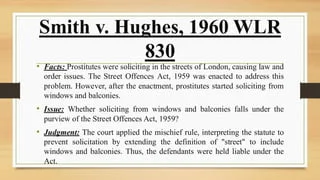
Smith v Hughes 1960 is officially reported as Smith v Hughes [1960] 1 WLR 830, and it was decided in the English criminal courts. The case arose under the Street Offences Act 1959, which was introduced to address public nuisance caused by street solicitation. The legislation aimed to regulate behaviour in public spaces and maintain order.
Smith v Hughes 1960 is frequently referenced in academic materials, including Smith v Hughes 1960 Wikipedia summaries and legal textbooks, because it provides a clear example of purposive interpretation. The legal background is essential for understanding why the court chose to interpret the statute broadly, focusing on Parliament’s intention rather than strict literal meaning.
Facts of Smith v Hughes 1960 Case Summary
In Smith v Hughes 1960 case summary discussions, the facts usually highlight that the defendants were prostitutes who solicited men from balconies and inside private buildings. Although they were not physically present in the street, their actions were directed at men walking in public areas. This created the central legal issue in the case.
Smith v Hughes 1960 full case materials explain that the defendants argued they were not technically “in a street” as required by the statute. However, their conduct clearly targeted individuals in public spaces. This factual background is crucial in understanding why the court considered the broader purpose of the law rather than its literal wording.
Legal Issue in Smith v Hughes 1960
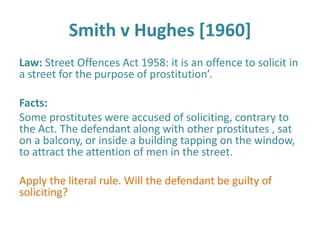
The main legal issue in Smith v Hughes 1960 was whether solicitation from private property could still amount to solicitation “in a street” under the Street Offences Act 1959. This question required the court to interpret the meaning of statutory language in a practical and purposive way.
Smith v Hughes 1960 judgement focused on whether the defendants’ actions fell within the intended scope of the legislation. The court had to decide whether Parliament intended to punish only physical presence in the street or also conduct that effectively influenced people in public spaces. This interpretive challenge made the case highly significant in UK law.
Judgment and Outcome of Smith v Hughes 1960
The court in Smith v Hughes 1960 ruled that the defendants were guilty under the Street Offences Act 1959. The judges concluded that even though the women were on private property, their actions were directed towards men in the street and therefore fell within the purpose of the legislation.
Smith v Hughes 1960 outcome is important because it confirmed that statutory interpretation should not be limited to strict literal meanings. The court ensured that the law could not be avoided through technical positioning. This decision strengthened the authority of purposive interpretation in UK criminal law.
Smith v Hughes 1960 and the Mischief Rule
Smith v Hughes 1960 mischief rule application is one of the most important aspects of the case. The mischief rule requires courts to identify the problem Parliament intended to fix and interpret the law in a way that suppresses that problem. This approach ensures that legislation achieves its intended purpose effectively.
In Smith v Hughes 1960, the court identified that the “mischief” was street solicitation causing public nuisance. Even though the defendants were not physically in the street, their behaviour created the same harm the Act was designed to prevent. Therefore, the court applied a purposive interpretation rather than a narrow reading.
Legal Principles from Smith v Hughes 1960
Smith v Hughes 1960 rule development highlights several key principles in statutory interpretation. One major principle is that courts may interpret statutes based on legislative intent rather than literal wording. This ensures that laws remain effective even when defendants attempt to exploit technical gaps.
Another important principle in Smith v Hughes 1960 case summary discussions is objective interpretation. The court considers how a reasonable person would understand the statute in its context. This approach strengthens consistency in legal reasoning and prevents unjust outcomes based on overly strict interpretations.
Smith v Hughes 1960 Citation and Legal Importance
Smith v Hughes 1960 citation, recorded as [1960] 1 WLR 830, is widely used in legal writing, case summaries, and academic research. It is frequently referenced in essays and exam answers involving statutory interpretation and criminal law principles. Its citation is essential for accurate legal referencing.
Smith v Hughes 1960 Wikipedia pages and legal databases often highlight its importance as a leading authority on the mischief rule. The case is also included in many law revision guides because it clearly demonstrates how courts interpret ambiguous legislation in line with parliamentary intent.
Modern Relevance of Smith v Hughes 1960
Smith v Hughes 1960 remains highly relevant in modern UK law because courts still face cases involving ambiguous statutory wording. The principles established in this case are applied in both criminal and civil law when interpreting legislation that may be open to different meanings.
Smith v Hughes 1960 summary discussions in modern legal education emphasise its continued influence. The case helps students understand how courts balance fairness, legislative intent, and legal certainty. It also shows how judicial interpretation adapts to social and legal changes over time.
Comparison with Other Interpretation Cases
Smith v Hughes 1960 is often compared with cases that apply the literal rule, such as Fisher v Bell. While literal interpretation focuses strictly on the wording of statutes, Smith v Hughes 1960 demonstrates how courts may go beyond text to achieve justice and legislative purpose.
Smith v Hughes 1960 full case analysis is also compared with Heydon’s Case, which laid the foundation for the mischief rule. Together, these cases form a strong framework for understanding how UK courts interpret legislation in a flexible and purposive manner.
Conclusion on Smith v Hughes 1960
Smith v Hughes 1960 remains one of the most important UK cases on statutory interpretation. It clearly demonstrates how courts apply the mischief rule to ensure that legislation is effective and aligned with Parliament’s intention. The case continues to be essential for legal education and practice.
Smith v Hughes 1960 case summary highlights its lasting importance in criminal law, especially in preventing individuals from exploiting technical loopholes. Its principles continue to shape modern judicial reasoning and ensure that laws are applied fairly and purposefully.
Frequently Asked Questions on Smith v Hughes 1960
What is Smith v Hughes 1960 case summary?
Smith v Hughes 1960 case summary explains a criminal law decision where the court applied the mischief rule to determine that solicitation from private property still fell within the scope of the Street Offences Act 1959.
What is the mischief rule in Smith v Hughes 1960?
The Smith v Hughes 1960 mischief rule refers to the court’s approach of interpreting legislation based on the problem Parliament intended to solve, rather than relying solely on literal wording.
What is the outcome of Smith v Hughes 1960?
The outcome of Smith v Hughes 1960 was a conviction, as the court ruled that the defendants’ conduct fell within the purpose of the Street Offences Act 1959.
Why is Smith v Hughes 1960 important?
Smith v Hughes 1960 is important because it is a leading authority on statutory interpretation and demonstrates how courts use purposive reasoning to apply legislation effectively.
What is the citation for Smith v Hughes 1960?
The official citation is Smith v Hughes [1960] 1 WLR 830, which is widely used in legal textbooks and academic writing.
What rule does Smith v Hughes 1960 establish?
Smith v Hughes 1960 establishes the application of the mischief rule, reinforcing that courts should interpret statutes in line with legislative intent.